Why websites?
Personal websites as an atproto onboarding strategy

If you follow me in any kind of microblogging context, you know my two loves and passions are: (1) Germ and (2) personal websites—in particular, personal websites that are free!
Lately, I've been having a whole bunch of conversations about personal websites with people who have no idea what atproto is. And from these conversations, I'm convinced that there is a huge Atmosphere-sized hole in the personal website market. Furthermore, I think we can use that as leverage to bring people into the open social world.
Who wants a website, anyways?
The masses are not necessarily clamoring for a website. So what am I on about?
Well, my target audience for websites is: people who want to be findable.
Findable, not discoverable. I think social media platforms are still undefeated for discoverability. (The exception, I suppose, is having great SEO and optimizing for agentic search, to make your website itself discoverable.)
But a lot of people just want to be findable. What should I put on my business cards? On my resume? In my playbill bio? On my grant application? What do I say when I'm talking to someone about my work, and they ask, "Where can I find you?"
The people I'm talking to who want websites are mostly artists. Journalists, furniture designers, photographers, tattoo artists, puppeteers, actors, costume designers, writers, directors, musicians.
And there are also businesses. People who need a virtual storefront! Because I love artists so much, the people I've talked to in this category are also artists—artists who are selling workshops and classes. But we can imagine this extending past the art world!
Right now I'm watching people use traditional social media platforms for findability and discoverability. But they're unhappy on traditional social media platforms! And I think we can win over the findability market by making websites easy and free. My proposal is: let's offer free atproto websites to capture the audience that wants to be findable... and then leverage that growth to boost the Atmosphere's attractiveness as a route for discoverability.
So... let's get into it!
Why are we stuck using traditional social media to be findable?
Many people still aim to be discoverable—to go viral, to gain followers, or to increase their reach among strangers. But on traditional social media platforms, discoverability comes with major risk! These platforms are very clearly and obviously prioritizing growth and engagement over the safety of creators with marginalized identities. So being discoverable is scary, and it's also hard to achieve viral success, even if that's something you're gunning for!
(Discoverability ≠ virality, and there are, of course, safer and friendlier ways to achieve discoverability. Let's do it in the Atmosphere!)
Needless to say, in the traditional social media landscape, discoverability is suuuper hit or miss. So, my artist friends are mostly aiming to just be findable—to friends and family, to friends of friends, to clients, to potential collaborators, to randos they've met once in person.
Okay, so great! Findability. That's a lower bar to clear than findability and discoverability. But somehow we're alllllllll stiiiillllllllll usinggggggg Innsstaaagrammmmm. WHYYYYYYY???
Almost everyone I know is "trying to quit Instagram." Many people have removed the app from their phone, relegating their usage to the clunky browser version. But I only know of a few people who have actually deactivated their accounts. Worse, several of my lifelong-social-media-hating friends have recently felt the need to create Instagram accounts to keep up in their artistic fields. (Instagram, unfortunately, is still LinkedIn For Artists. Much to the chagrin of artists.)
The zeitgeist is on our (atproto's) side—it's increasingly common knowledge that the big social media platforms trap you, scrutinize you, and wring you out for data and engagement. But the activation energy to switch platforms is often lacking.
Because traditional social media is:
- Free
- Very easy to use
- Holding hostage our entire network of weak ties (loose acquaintances—friends from summer camp, high school classmates, the person standing next to you at that concert that one time—who we rarely talk to but who we will maybe never be able to find ever again if we delete this app, and that would stink!)
(This list is not in comparison to Atmosphere apps, which are also generally free and easy to use. It is in comparison to traditional website builders. Bear with me!)
Furthermore, for someone to adopt a new (mobile) social media app, they need to:
- Download a new app
- Convince all their friends to download the same new app
- (Or, in a networking context:) Convince someone they've just met, in this very conversation, to download the same new app, without losing the original thread of conversation
(Admittedly, if we're talking about web apps, the download hurdle shrinks into just account creation. And even mobile apps have workarounds for this! Someone can text you on Germ, for instance, without actually having the app, but that's because we use Apple's App Clip technology, which is, in fact, #CoolAsHell.)
Despite this cold start problem, newcomers are breaking into the market all the time! It's doable, and it's important.
But for a moment, let's just think about findability (overlooking, temporarily, all the sick nasty awesome features/tools/communities all you sick nasty awesome atproto devs are building). If people are stuck using traditional social media as a matter of findability... why can't they just make a website?
Which brings me to: The Website Situation.
Everyone wants a personal website, but no one has one...?
The consensus (among my non-technical peers) seems to be that if you really wanted a website, you could make one on Squarespace, but that you need to reeeeally want a website to go to such lengths.
Honestly I'm wondering if it's because drag-and-drop websites are so customizable that it scares people away. You try to make a website, and—BOOM!—right away it gives you five pages including a blog and a photo gallery, and your default homepage is this never-ending scroll of lorem ipsum sections that is clearly built to show you what's possible from a layout perspective but instead makes it feel like you can only publish your website once you've come up with (1) a blurb and snappy tagline, (2) multiple testimonials, and (3) something that can be expressed as a list of three.

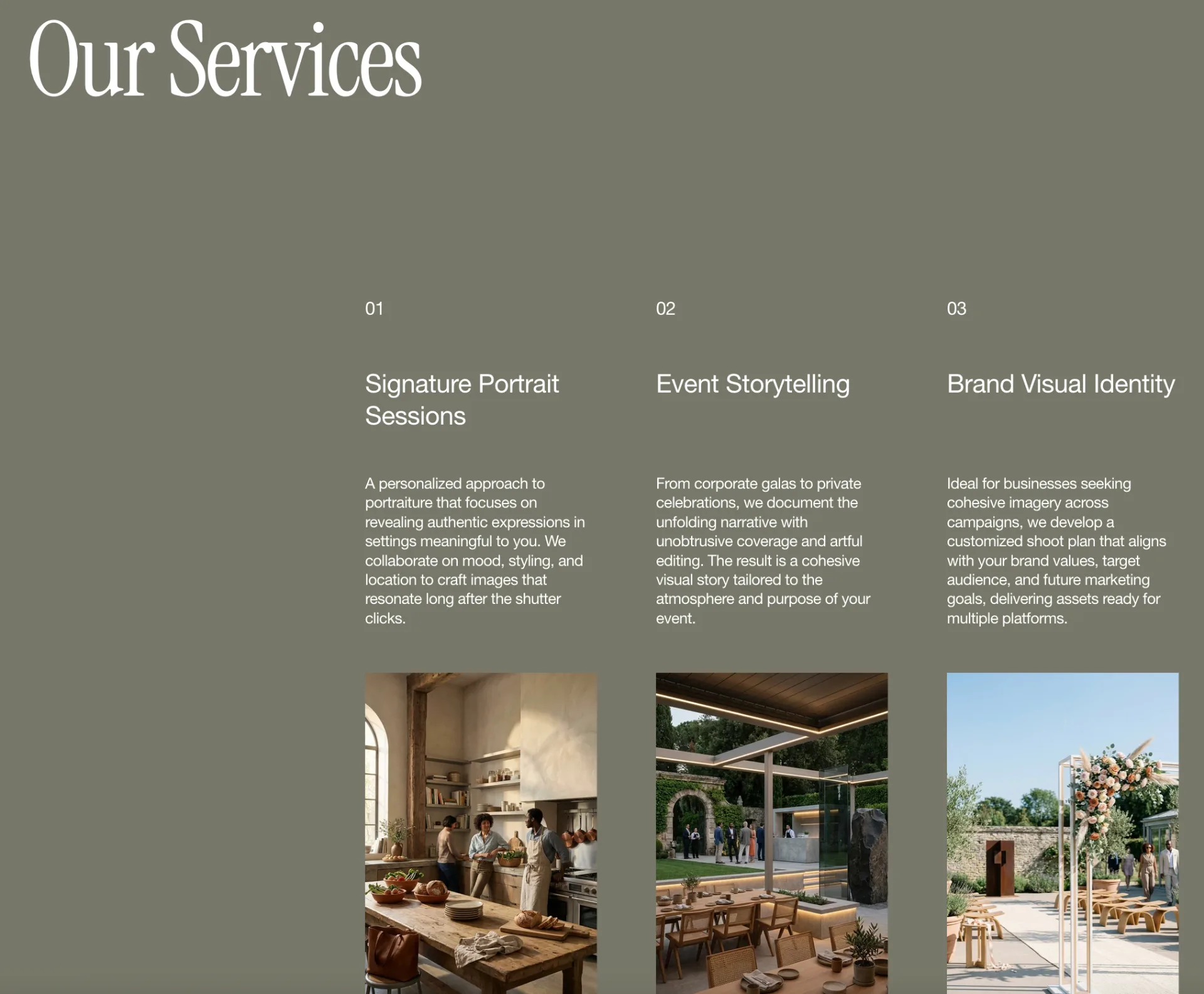
And then you have to figure out if you're going to keep the Contact Form in there or not. It's no wonder that no one wants to make a website!
And most people's personal websites operate as portfolios/CVs, so you're supposed to get back in there regularly and update it?? Nightmare material. It's gotta be some kind of 100x drop-off between each of those levels.
Here, I made a diagram to illustrate:

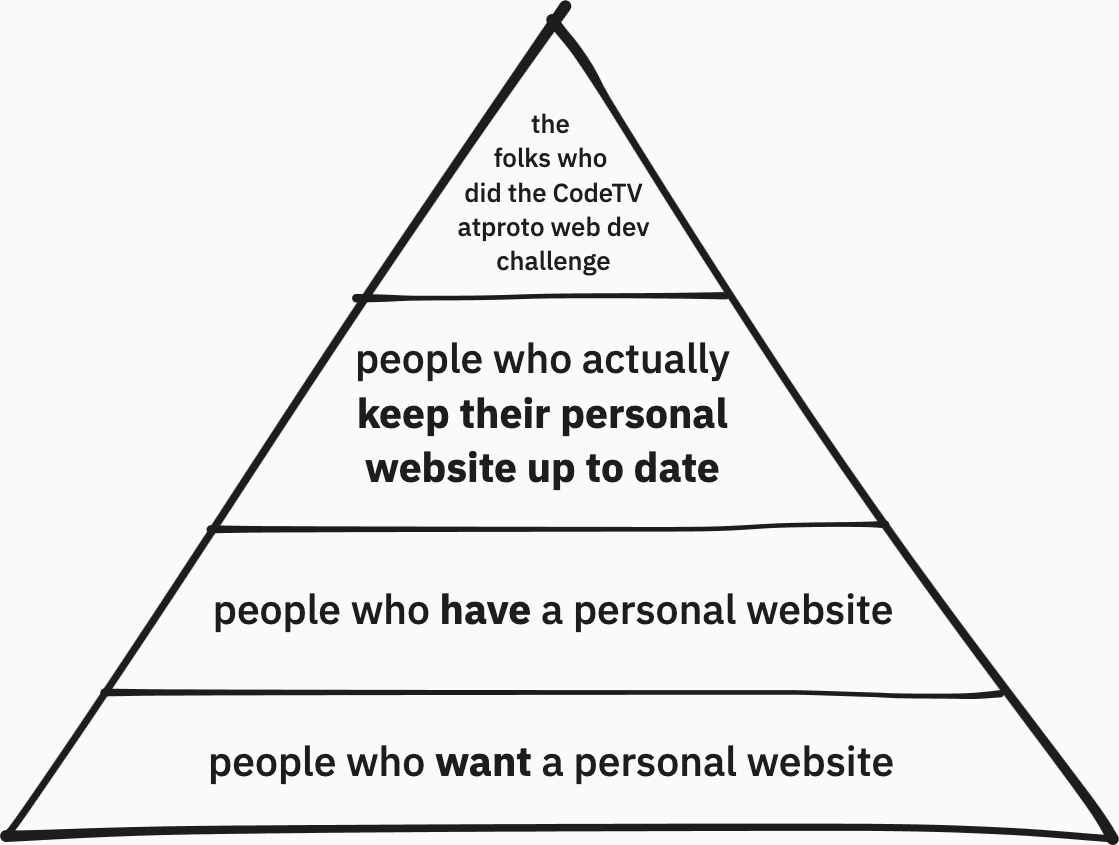
So, suuuuuuure, maybe the person you're talking to has a website already. But odds are, even if they already have a website, they would scrap it in a heartbeat if you offered them something easier or better.
And in addition to all the struggles of making and maintaining one of those classic drag-and-drop websites, you're probably paying something like $20/month for it.
When it comes to personal websites, we are not used to the free and frictionless experience that traditional social media offers! There's plenty of space to innovate, and atproto gives us the tools to make really appealing alternatives.
But that's not all.
Websites don't face the cold start problem!
Websites are basically all accessible the exact same way: from a browser.
And IMO this is a pretty important reason why atproto website builders could grow quickly:
How you make it is not how you view it.
If you make a cute new website for yourself, you don't need to convince all your friends to download a new app to view it. Everyone's got their preferred browser, and that browser can (basically) render your website (basically) regardless of how you made it.
Which frees you up to do whatever the hell you want! You don't need to wait for your friends to catch up. And that empowers you to explore and switch over to tools that actually feel good to use.
I've made a little table to highlight the benefits here:
Drawing people in via a social media alternative | Drawing people in via a website building alternative | |
|---|---|---|
Money saved! | You save $0! | You save $20/month! |
Creator lift | Need to use a different tool | Need to use a different tool |
Viewer lift | Need to use a different tool | None |
Let's just take a moment to appreciate that "how you make it is not how you view it" applies to, not just websites, but everything on the Atmosphere. What a dream!
And that's the end goal here: to bring people onto the Atmosphere.
Once we're all on atproto websites, we're all on atproto!
You've gotta make an Atmosphere account to make an Atmosphere website.
And maybe that's all you see of the Atmosphere (at first).
Maybe you don't want to be pitched (yet) on all the other things you can do with your account.
But hey, you're on the Atmosphere!
I'll only speak for myself and not all Atmosphere devs, but I'm choosing to develop on atproto because I believe it's the future. I think that one day everyone will be happily on the open social web—it's only a matter of time.
I'm excited about personal websites as potentially low-hanging fruit for atproto growth. But websites only make up a small piece of the future enabled by atproto. The open social web is giving us the opportunity to escape the toxic confines of traditional social media platforms!
JD, Head of Trust and Safety at Blacksky, recently wrote an incredible blog post describing how traditional social media operates as a prison. They ended the post with a call to action:
The prison might prevail today, but Blacksky and platforms like it are actively disrupting its culture and economy. In a world where antiblackness and other forms of online violence are ever-present and engineered to compel engagement, that intervention is not optional; it’s necessary.
Platforms like Blacksky are building a freer and healthier digital future and putting control back in the hands of users and communities. And their success is not contingent on the popularity of the AT Protocol—these platforms have their own powerful resonance with users.
Something the Atmosphere can do, to support these projects, is to continue growing our shared user base! And I think atproto websites can serve as a clever transitional tool to help us build towards critical mass. For users who are hesitant to challenge the social media status quo, websites can provide an easy entry-point into the Atmosphere. Meanwhile, behind the scenes, that user's Atmosphere account has stealthily unlocked the rest of the Atmosphere for whenever they are ready to explore.
It's a way to build past the cold start problem without ever subjecting new users to the cold start experience. The question is... how do we start laying out the groundwork now for website users to build their Atmosphere social graphs?
In fact, there is so much to say about how we might facilitate the pipeline from Atmosphere website user to Atmosphere netizen, but I think that belongs in a future post. Speaking of future posts...
What's next?
There are obviously a million billion things to say about Atmosphere-backed websites, and I'm so excited to see where those conversations lead. For this series of blog posts, I've chosen a framework that is an oldie but goodie: WHOWHATWHEREWHENWHYHOW!
- who websites: who are the atproto devs and projects addressing (directly or indirectly) portfolios, resumes, and personal websites, and how can we collaborate on lexicons and integrations?
- what websites: what is the ideal creator-side and consumer-side UX for a personal website, and how might that differ for e.g. a visual artist vs. a journalist vs. a scientist?
- where websites: outside of any one platform, what does it mean to navigate to a handle, to a post, to a profile?
- when websites: what does the timeline and process look like for introducing atproto website users to the rest of the Atmosphere?
- (✓) why websites: why should we be using websites as an atproto on-ramp?
- how websites: how can we use the affordances of atproto to make easy experiences and integrate websites with the rest of the ecosystem?
Much to discuss! I'm excited to explore with you all.
xoxo,
Anna